

R&D Innovation
A scientifically grounded approach to innovation has now been developed, and an increasing number of companies and institutions are adopting it. In fact, the government of Dubai—which has declared its intention to become one of the world’s most innovative countries within seven years—has already implemented the CEN/TS 16555 “Innovation Management,” which summarizes the modern science of innovation. This scientifically grounded standard is based on a common language and established knowledge, and it promotes the evaluation and benchmarking of innovation. Furthermore, adherence to this standard is a prerequisite for accessing grant funding, successfully participating in public procurement tenders, and forming partnerships. Those who do not prepare in time to apply methods based on this common language and shared knowledge will fall behind and, indeed, miss out on a wide range of opportunities.
In fact, around the world—including in Hungary—more and more companies are deciding to learn about the science of innovation, teach it to their employees, and then integrate it into their business operations in order to increase their competitiveness. In fact, companies that integrate the science of innovation into their strategic planning, budgeting, and resource allocation are SIX TIMES more likely to achieve their desired financial goals.
The greatest challenge is how to capture, organise, and preserve this knowledge—especially the valuable knowledge held by individuals—and how to unlock people’s creativity, expertise, and innovative potential to achieve shared goals.
Although the importance of innovation has been recognised for decades, organisations have often relied on fragmented, ad hoc, and sometimes conflicting approaches to innovation management. As a result, expected outcomes were frequently not achieved due to a lack of high-quality ideas and insufficient focus on managing the innovation process from concept to implementation. Drawing on years of experience and extensive research, the CEN/TS 16555 Innovation Managementstandard was developed to provide a structured, practical, and internationally recognised framework for managing innovation. The standard has also been adopted as the Hungarian national standard under the designation MSZ CEN/TS 16555 Innovation Management.
The purpose of the standard is to provide guidance for organisations in establishing, developing, and maintaining systematic innovation management practices and an effective Innovation Management System (IMS). In essence, it serves as both a practical framework and a comprehensive checklist, enabling organisations to benefit from a structured, science-based approach to innovation.
Although the importance of innovation has been recognised for decades, organisations have often relied on fragmented, ad hoc, and sometimes conflicting approaches to innovation management. As a result, expected outcomes were frequently not achieved due to a lack of high-quality ideas and insufficient focus on managing the innovation process from concept to implementation. Drawing on years of experience and extensive research, the CEN/TS 16555 Innovation Managementstandard was developed to provide a structured, practical, and internationally recognised framework for managing innovation. The standard has also been adopted as the Hungarian national standard under the designation MSZ CEN/TS 16555 Innovation Management.
The purpose of the standard is to provide guidance for organisations in establishing, developing, and maintaining systematic innovation management practices and an effective Innovation Management System (IMS). In essence, it serves as both a practical framework and a comprehensive checklist, enabling organisations to benefit from a structured, science-based approach to innovation.
Components of the CEN/TS 16555 “Innovation Management” Standard
An increasing number of organisations in Hungary have already begun implementing—or preparing to implement—the CEN/TS 16555 Innovation Management standard to strengthen their long-term competitiveness. Establishing an innovation management system in line with the standard not only improves the efficiency of innovation activities but also significantly enhances an organisation’s ability to collaborate with partners. By adopting a common innovation management framework, organisations become more compatible with others using the same standard, enabling them to share a common language and work more effectively in joint innovation and development projects. This trend is contributing to higher levels of innovation and increased value creation across the Hungarian economy.
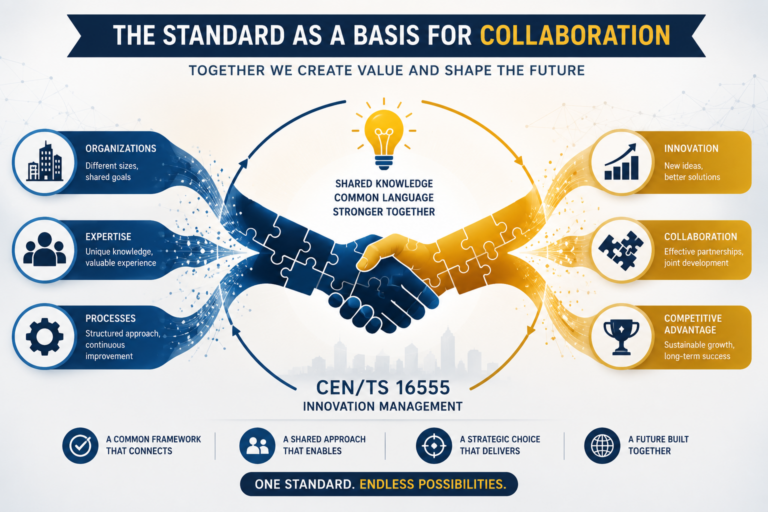
One of the most effective ways to achieve this is by strengthening innovation capability. Increasingly, manufacturers of complex products—such as automotive companies—expect their suppliers not only to deliver components but also to contribute actively to the development of new prototypes and manufacturing technologies within their areas of expertise. Such collaboration can only be truly effective when partners operate compatible Innovation Management Systems (IMS) and share a common innovation language. The CEN/TS 16555 Innovation Management standard provides this common framework, enabling organisations to transform documented knowledge and employees’ expertise into business value by unlocking creativity, innovation, and intellectual capital.
Since establishing and implementing an Innovation Management System (IMS) in accordance with the standard typically takes several years, organisations are encouraged to begin the process as early as possible. Early adoption enables companies to identify and seize new business opportunities more quickly, strengthen their competitive position, and participate successfully in strategic partnerships and funding opportunities rather than falling behind their competitors.
Since establishing and implementing an Innovation Management System (IMS) in accordance with the standard typically takes several years, organisations are encouraged to begin the process as early as possible. Early adoption enables companies to identify and seize new business opportunities more quickly, strengthen their competitive position, and participate successfully in strategic partnerships and funding opportunities rather than falling behind their competitors.
Trebag Intellectual Property and Project Management Ltd. has extensive experience in supporting the implementation of Innovation Management Systems (IMS).
With Trebag’s support, the implementation of the CEN/TS 16555 Innovation Management standard was launched at the Hungarian manufacturing site of a major international company. Even during the initial phase of implementation, the collaboration resulted in the development of a research and innovation programme that led to the establishment of a consortium, which successfully secured several billion Hungarian forints in funding under the GINOP “R&D Competitiveness and Excellence Collaborations” programme.
In addition, Trebag has delivered Innovation Management training for 40 companies and has carried out the preparatory work required for the implementation of Innovation Management Systems in 40 organisations.
In addition, Trebag has delivered Innovation Management training for 40 companies and has carried out the preparatory work required for the implementation of Innovation Management Systems in 40 organisations.
TREBAG Kft.’s services for implementing the standard:
Add an overline
The key to change is within your reach. We are ready to support your organisation in taking the next step towards a future driven by innovation, growth, and business success.
This guide is based on a publication by Magnus Karlsson (Director, New Business Development & Innovation, Ericsson) released by the Swedish Standards Institute in April 2016, as well as on the research and experience of TREBAG Intellectual Property and Project Management Ltd.
In his publication, Magnus Karlsson also drew on publications by the following renowned institutions and individuals: Gartner Research (2010) / SKL (2014) / McKinsey (2013) / Geoffrey Moore / Govindarajan & Desai and The Innovator’s DNA / Study of Ericsson managers & employees (2014) / Capozzi & Kellen, McKinsey (2012) / Gartner (2014).
In his publication, Magnus Karlsson also drew on publications by the following renowned institutions and individuals: Gartner Research (2010) / SKL (2014) / McKinsey (2013) / Geoffrey Moore / Govindarajan & Desai and The Innovator’s DNA / Study of Ericsson managers & employees (2014) / Capozzi & Kellen, McKinsey (2012) / Gartner (2014).